Oct. 12, 2026
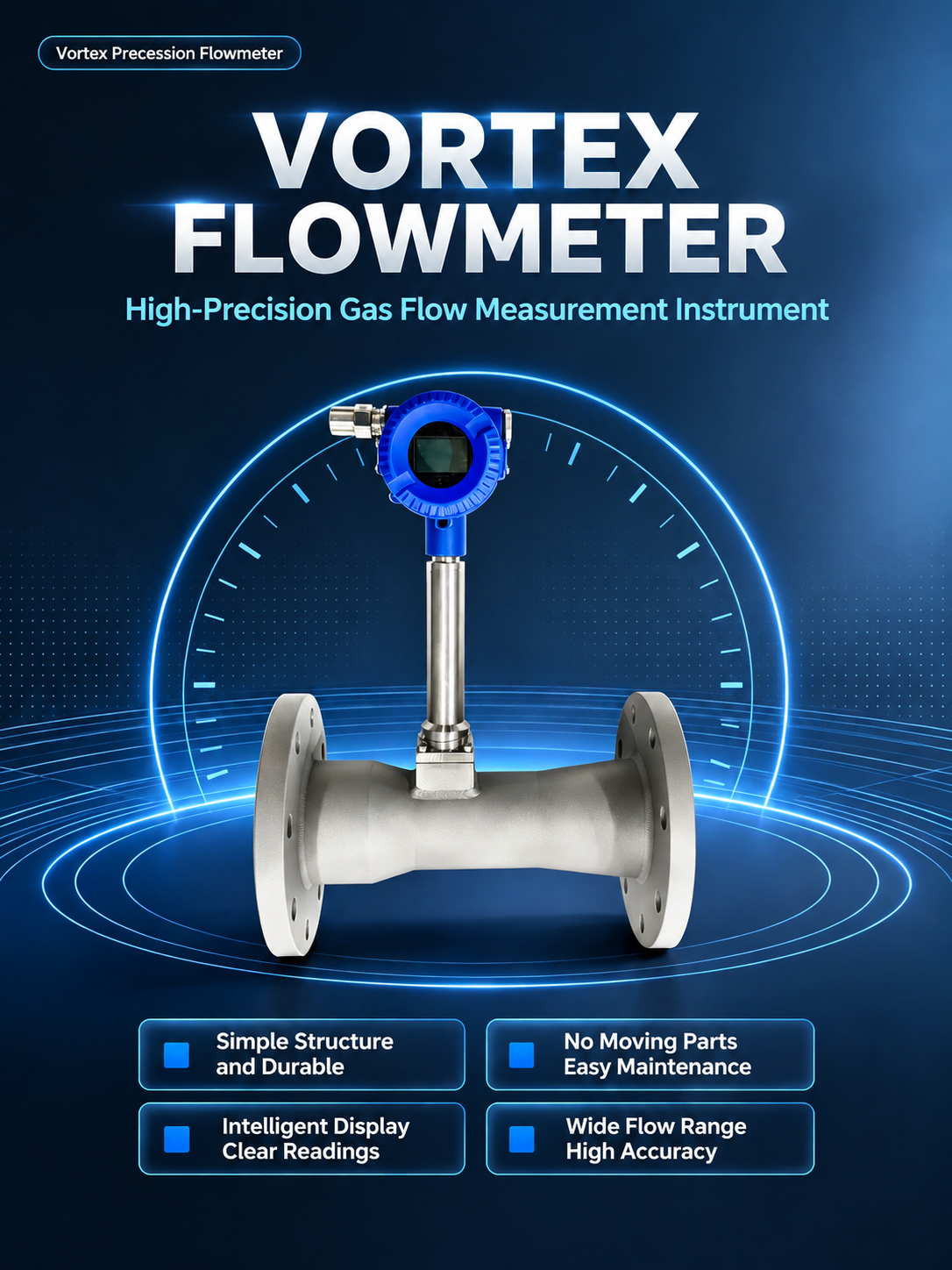
Designed primarily for gas measurement, this flowmeter is suitable for clean single-phase gas. It has no rotating parts and features a wide turndown ratio. It is widely used for metering natural gas, compressed air, nitrogen, coal gas and other gases. **Not recommended** for media with abundant liquid droplets, dust or strong corrosives.
1. Confirmation of Medium Properties
Optimal media: dry single-phase gases such as natural gas, compressed air, nitrogen and biogas.
For media containing condensate, oil contamination or dust, a filter and gas-liquid separator must be installed upstream.
For media with hydrogen sulfide or chloride ions, 316L or Hastelloy alloy is required as the construction material.
Medium state: Use with caution for wet gas carrying large amounts of liquid droplets. Generally not recommended for liquid service (Vortex or electromagnetic flowmeters are preferred for liquids).
Medium composition: Gas composition data (relative density, CO₂ and N₂ content) must be provided for natural gas custody transfer metering to convert volumetric flow to standard conditions.
2. Flow Calculation & Sizing
Key note: Distinguish between standard volumetric flow Nm³/h and operating volumetric flow m³/h. Manufacturer datasheets list operating volumetric flow. Most natural gas flow data provided by customers are standard flow values, which must be converted to operating flow using the ideal gas law prior to meter sizing.
Collect three flow parameters: minimum flow Qmin, normal flow Qnormal and maximum flow Qmax (including future expansion capacity).
Optimal operating range: Normal flow shall fall within 30% ~ 80% of the meter range. Avoid long-term operation near the lower limit or full scale.
Sizing principles:
- Pipe DN ≠ flowmeter DN. Do not select meter size simply based on pipe nominal diameter.
- If two sizes both cover the required flow, select the smaller size when system pressure drop permits for better low-flow sensitivity.
- When reducing pipe size, install reducers and ensure sufficient straight pipe sections.
Caution: Vortex precession flowmeters generate higher pressure loss than vortex flowmeters. Verify allowable system pressure drop during selection to prevent gas supply shortage.
3. Pressure, Temperature & Housing Material
Nominal pressure PN: Select according to pipe design pressure with a safety margin of 1.2~1.5 times.
- ≤2.5 MPa: Aluminum alloy housing commonly used
- ≥4.0 MPa: Stainless steel or cast steel housing
Medium temperature: Confirm maximum and minimum medium temperature. Standard range: -20~80℃; high-temperature versions available on custom order.
Material selection:
- Clean non-corrosive gas: 304 stainless steel
- Corrosive gas (H₂S, Cl⁻): 316L, Hastelloy alloy
4. Accuracy & Temperature / Pressure Compensation
Accuracy class:
- Custody transfer: Class 1.0
- Internal energy consumption monitoring: Class 1.5
Turndown ratio: Standard 1:20; some models reach 1:30.
Temperature & pressure compensation:
✅ Integrated temperature and pressure compensation is mandatory for natural gas and fuel gas custody transfer to directly output standard volume.
Compensation is unnecessary for applications only monitoring operating flow with stable pressure
5. Explosion Proof, Ingress Protection, Power Supply & Output Signals
Explosion protection: For flammable and explosive locations (gas stations, chemical plants): Ex d ⅡCT6 / Ex ib ⅡCT6. Non-explosion-proof version for ordinary workshops.
Ingress protection: IP65 for indoor installation; IP67 for outdoor / humid environments.
Power supply:
- Local display only: Built-in lithium battery
- With 4-20mA and RS485 remote transmission: DC24V external power supply; dual power supply (lithium battery + 24V) optional.
Output signals: Pulse, 4~20mA, RS485 Modbus; HART supported on selected models.
6. Additional Site Operating Conditions
Vibration: Use cautiously in high-vibration locations. Vibration isolation supports may be required; keep away from pumps and compressors.
Electromagnetic interference: Keep away from frequency converters and high-power motors. Use shielded cables with proper earthing.
Straight pipe requirements: Upstream ≥3~5DN, downstream ≥1DN. Longer straight pipe sections are required after valves, elbows and pressure regulators.
Installation orientation: Horizontal or vertical mounting is acceptable. For gas with condensate, horizontal installation is recommended with the sensor not facing downward.
7. Common Selection Pitfalls
❌ Selecting flowmeter DN directly equal to pipe DN, resulting in oversized meter for low flow and poor low-flow measurement
❌ Comparing standard flow directly against operating flow datasheets, leading to incorrect sizing
❌ Missing temperature and pressure compensation for fuel gas custody transfer, invalidating metering results
❌ Neglecting pressure drop and causing insufficient pressure in the gas supply system after installation
❌ No water separator or filter for media with heavy condensate, leading to sensor fouling and failure
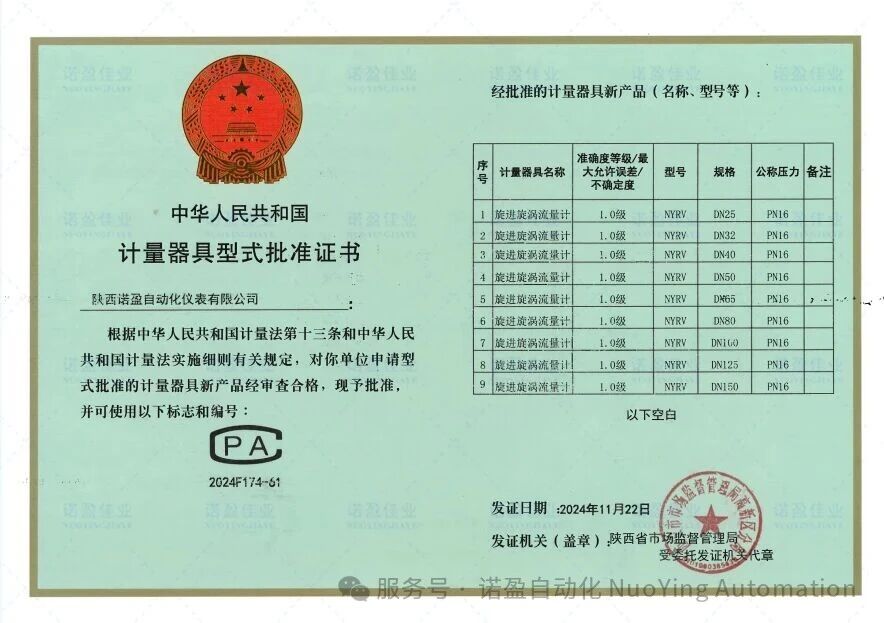
Our vortex precession flowmeters hold complete type approval certificates, with metering accuracy up to Class 1.0. Featuring reliable and stable measurement data, they are suitable for gas media including natural gas, compressed air and coal gas. Widely applied in gas custody transfer, boiler room gas supply monitoring, chemical process gas distribution, metallurgical and mining gas metering and other scenarios.
Professional OEM & ODM Manufacturer
Tailored products to meet your complex working conditions.

Shaanxi NuoYing Automation Instruments Co., Ltd.
Navigation
Navigation
Contact Us
+86 182 1004 9286
+86 182 1004 9286
+86 182 1004 9286
Block V5, Ronghao Industrial Town, Gaoling District, Xi'an, Shaanxi, China.