Sep. 18, 2026
Capacitive level switches are widely used for point-level monitoring in industrial storage tanks, chemical vessels and processing containers. Many system designers raise a common question: Can capacitive level switch work for conductive and non-conductive liquids?
The short answer: Yes. Capacitive level switches can detect both conductive and non-conductive liquids, but different probe structures and insulation designs are required for these two categories of media. The sensing logic changes slightly when applied to conductive liquids versus non-conductive liquids.
This guide explains the underlying working principle, distinguishes the detection modes for conductive and non-conductive liquids, provides a comparison table with other common point-level sensors, and lists practical selection & installation notes for industrial tank projects.
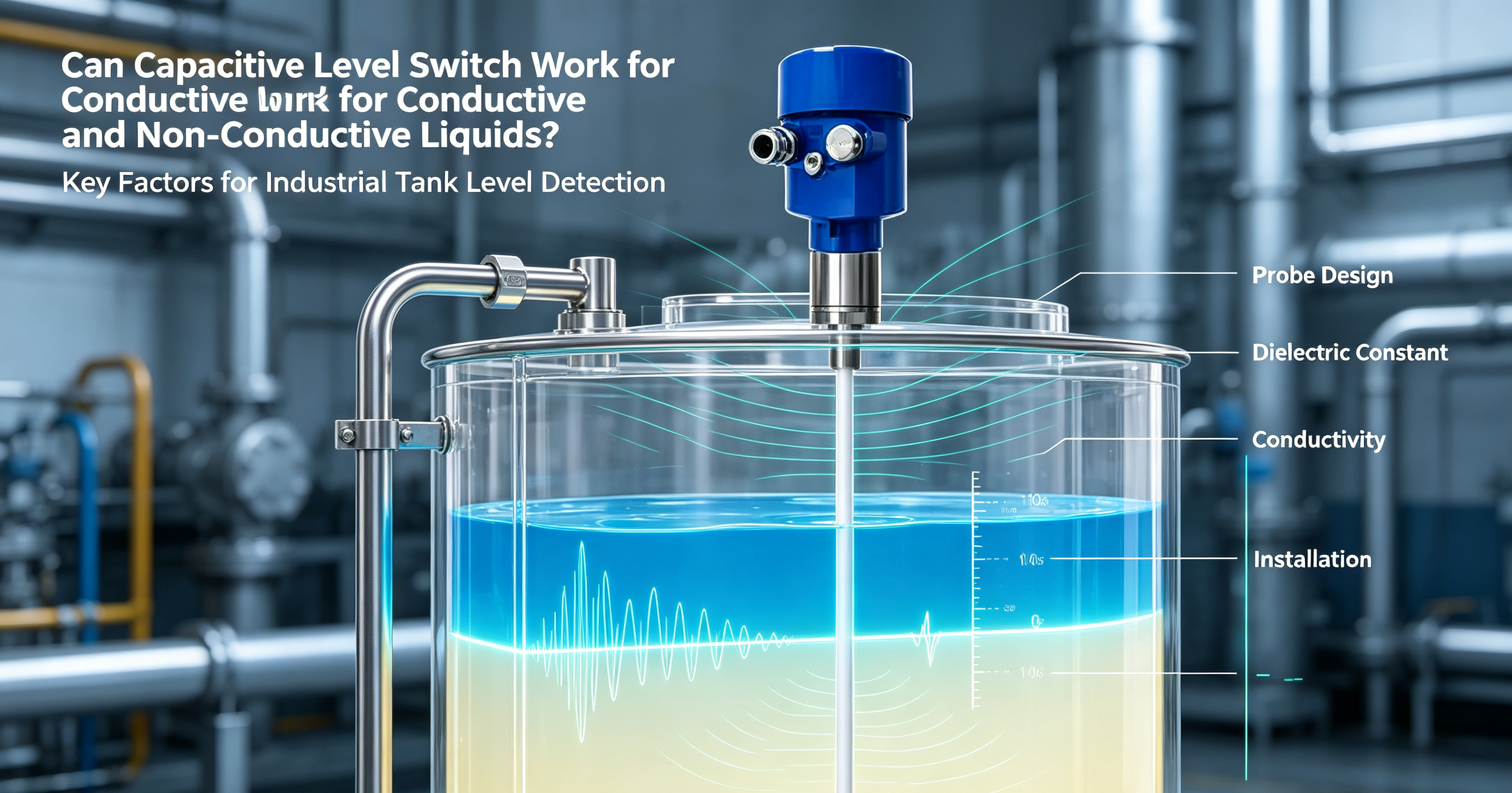
Capacitive level switches operate based on capacitance variation. The sensing probe forms one electrode of a capacitor, and the conductive tank wall (or a separate reference electrode for non-metal tanks) serves as the second electrode. The dielectric material between the two electrodes decides the capacitance value.
Air has a low dielectric constant. When liquid rises and covers the probe, the medium replaces air around the probe, and the capacitance value changes. The circuit identifies this capacitance shift and triggers a switch signal for high/low level alarm or pump interlock control.
Conductive liquids include water, aqueous acid, alkali, salt solution and most water-based chemical fluids. For conductive media, the liquid itself acts as the second electrode. The probe must be covered with an insulating layer such as PTFE or PFA. The insulation coating becomes the dielectric layer between the metal probe and conductive liquid, preventing short circuit. When the liquid submerges the insulated probe, capacitance changes and the switch output activates.
Non-conductive liquids include oil, fuel, pure solvent, deionized oil and organic liquids with low conductivity. For non-conductive media, the liquid works as the dielectric between the probe and tank wall. Bare metal probes or simple coated probes are acceptable. When liquid covers the probe, the higher dielectric constant of liquid replaces air, creating measurable capacitance change. No risk of short circuit occurs in this working mode.
⚠️ Key Note: The same probe cannot be directly used for both conductive and non-conductive liquids without correct insulation configuration. Insulation design is the core difference between these two applications.
The table below compares capacitive level switches with other commonly used point level sensors, showing their performance for conductive and non-conductive liquid measurement.
| Sensor Type | Detect Conductive Liquids | Detect Non-Conductive Liquids | Moving Parts | Resistance to Viscous / Sticky Media | Main Limitations |
|---|---|---|---|---|---|
| Capacitive Level Switch | ✅ Yes (Insulated probe required) | ✅ Yes | ❌ No | Good, medium adhesion may cause drift | Sensitive to large dielectric constant changes; heavy coating affects stability |
| Tuning Fork Level Switch | ✅ Yes | ✅ Yes | ❌ No | Limited, heavy buildup dampens vibration | Not suitable for heavy sticky coating or high viscosity media |
| Float Level Switch | ✅ Yes | ✅ Yes | ✅ Yes | Poor, sediment may jam float | Mechanical wear, not ideal for high viscosity or corrosive media |
| Conductive Level Switch | ✅ Yes | ❌ No | ❌ No | Medium | Only works for conductive aqueous liquid; cannot detect oil/solvent |
Check the liquid conductivity first.
If the liquid is viscous, sticky or easy to form deposits on the probe, capacitance reading may drift over time. For such conditions, sensors with compensation circuits can be considered to reduce measurement drift.
For chemical tanks with corrosive media, the probe insulation material must match chemical compatibility. For flammable or explosive liquid environments, equipment with corresponding explosion-proof certification should be selected.
Avoid installing the probe at inlet, outlet or stirring zone. Liquid splashing and turbulence may create false level triggering.
✅ Conductive Liquid Cases Chemical aqueous solution tanks, wastewater tanks, acid & alkali storage tanks, water buffer tanks. Use insulated PTFE/PFA probes.
✅ Non-Conductive Liquid Cases Oil storage tanks, solvent tanks, fuel tanks, pure organic liquid vessels. Select bare or lightly coated probes based on chemical compatibility.
❌ Scenarios That Need Extra Evaluation Heavy sticky slurry, media with strong coating property, liquids with extremely low dielectric constant. Additional site calibration is required.
A: It can be done with properly insulated probe and calibration. But users need to check the difference of dielectric constant between two liquids. If the difference is small, stable switching signal may be hard to obtain.
A: Foam may create partial capacitance change. Thick or dense foam can trigger false signal. For heavy foaming tanks, other point level technologies can be evaluated as alternatives.
A: Periodic calibration helps maintain stable performance, especially for media that tends to form coating on probe surfaces.
Capacitive level switches can work for both conductive and non-conductive liquids, but probe construction and insulation design must match the liquid type. For conductive liquids, insulated probes prevent short circuit. For non-conductive liquids, the liquid itself acts as dielectric. Without mechanical moving parts, capacitive point level switches are a practical option for tank high/low limit monitoring.
Before final selection, evaluate liquid conductivity, dielectric constant, fouling risk, tank material and working conditions to select a suitable probe configuration and reduce unexpected signal deviation.
Professional OEM & ODM Manufacturer
Tailored products to meet your complex working conditions.

Shaanxi NuoYing Automation Instruments Co., Ltd.
Navigation
Navigation
Contact Us
+86 182 1004 9286
+86 182 1004 9286
+86 182 1004 9286
Block V5, Ronghao Industrial Town, Gaoling District, Xi'an, Shaanxi, China.